{{ root_page.title }}
Early Years
What is Early Years? 
Early years education is about the care and learning your child receives at nursery, preschool, playgroup, or with a childminder from birth to five years, before they begin compulsory schooling.
It supports every part of their development—helping them grow physically, socially, emotionally, and mentally.
These early years are a key time for building the skills and confidence they'll need as they grow and learn.
What is the Early Years foundation stage (EYFS) framework?
The Early Years Foundation Stage (EYFS) is a framework used in England that sets the standards for the learning, development, and care of children from birth to age five. It’s what nurseries, preschools, childminders and reception classes in schools follow to make sure children are supported in all areas of their growth before they start Year 1.
The EYFS focuses on helping children learn through play, exploration and real-life experiences. It covers key areas like:
1. Prime areas of development:
- Communication and language
- Physical development
-
Personal, social and emotional development
2. Specific areas of learning:
- Literacy
- Mathematics
- Understanding the world
-
Expressive arts and design
The EYFS also includes guidelines to make sure children are kept safe, well cared for and are making progress in a way that suits their individual needs.
For parents, the EYFS helps you understand how your child is learning and developing, and encourages strong communication between you and your childcare provider or school.
The EYFS outlines how they make arrangements to support children with SEND and give parents information about this.
You can access a family guide to EYFS from the Early Years Alliance here:
Family Corner: An EYFS family guide
What am I entitled to in terms of Early Years Childcare?
The Early Years Childcare Entitlement refers to the government-funded childcare support available to families in England to help with the cost of early education and care for young children. It allows eligible children to access a set number of free childcare hours each week.
Here's a link to a breakdown of the current and expanded offer:
UK Government: 15 & 30 hours childcare
This link from Havering sets out the current advice and guidance:
Havering early years, childcare and funding page
📝 How to Apply:
You can apply for the extended (30-hour) entitlement and check your eligibility through the official government website: www.childcarechoices.gov.uk
Where can I get advice about SEN issues?
The Early Years SENCo:
The SEND Code of Practice states that every early years provider must have arrangements in place to identify and support children with SEN or disabilities and should appoint a designated practitioner with responsibility for special needs.
In early years settings, a SENCo (Special Educational Needs Coordinator) is the trained professional who ensures that children with SEND receive the support they need. They work with staff, parents, and other professionals to create an inclusive environment and put in place the necessary support to help children thrive.
There should be no expectation that the SENCo should do all the direct hands on work with every child in the setting who has additional needs. Rather, this person’s purpose is to oversee the day-to-day implementation of the setting’s SEN policy.
If you have concerns about your child's progress or if the health visitor or the educational setting make you aware of additional support that your child may need, then it is important that there is good communication between you as the parent/ carer and the SENCo and key worker.
Records about children must be available to the parent/ carer and must include information about how the setting supports children with SEN and disabilities.
Special educational provision given to children is called SEN Support. The SEND Code of Practice (CoP) 2015 recommends a graduated approach with four stages of action:
Assess; Plan; Do; Review.
For further information on SEN Support please refer to Chapter 5 'Early Years Providers' from Page 78 in the CoP. This chapter explains the action early years providers should take to meet their duties in relation to identifying and supporting all children with SEN, whether or not they have an education, health and care (EHC) plan.
The SEND CoP can be accessed via the link below:
Paragraph 5.48 CoP states that decisions by early years settings to involve specialists should be made with the child's parent/ carer...
“...where a child continues to make less than expected progress, despite evidence-based support and interventions that are matched to the child’s area of need”.
In cases where SEN Support is insufficient to meet the child's need then an EHC plan may be necessary. It is recommended that you discuss whether there is a need for this type of support with the SENCo. An application can be made to the local authority for an initial EHC needs assesment by the educational setting or the parent/ carer.
Please see the 'Education, health and care plan' section in the 'I am a parent/ carer' main menu for more details.
The SEND Early Years Support Service (London Borough of Havering Local Authority):
The SEND Early Years Support Team provide specialist support to promote early intervention and inclusive practice for children aged 0-5 with special educational needs and/or disability. The team consists of early years specialists who support children and families within the home and early education settings in the private, voluntary, independent sector and maintained nurseries.
The team work with children with a range of developmental difficulties, including those with complex needs either directly or indirectly through the offer of advice, support, modelling strategies and techniques, contributing to assessments, liaising with other support services, transitions and training.
The SEND Early Years Support Service is made up of a manager, area SENCos, advisory teachers, key workers, an educational psychologist and business support. SEND concerns relating to a child in early years can be referred to this team by the SENCo or a parent/ carer as follows:
Email: [email protected]
Telephone: 01708 434 080
Weblink : SEND Early Years Support Service
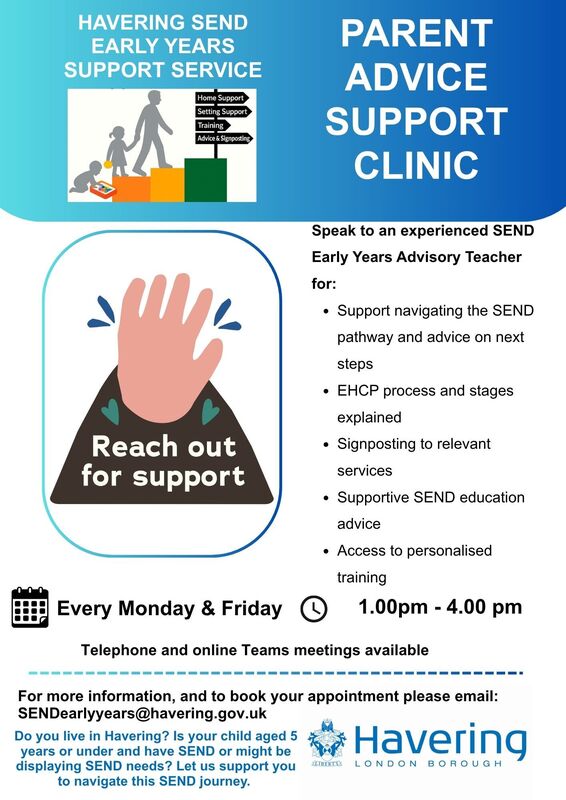
Early Years SEND Parent Advice Support Clinic
The Early Years SEND advisory Teachers (who make up part of the SEND Early Years Support Service at Havering) are available to give advice and guidance to Havering parents/ carers with concerns related to SEN through their Early Years SEND Parent Advice Support Clinic. They can guide you through the SEND process and answer any specific questions you may have.
The clinic is held on Mondays and Fridays 1pm-4pm via telephone or a TEAMS call and you need to email the team in advance to request a slot.
Email: [email protected]
The Local offer:
Havering has a local offer, which sets out information about provision they expect to be available across education, health and social care for children and young people in their area who have SEN (Special Educational Needs) or are disabled.
The local offer for early years can be accessed via the following link: 0 to 5 early years local offer